Past Progressive: Acciones Paralelas y Momentos Específicos en Inglés
Domina el Past Progressive en inglés. Aprende a expresar acciones continuas en momentos específicos del pasado y eventos paralelos simultáneos. En esta clase de gramática descubrirás la estructura correcta, ejemplos prácticos y obtendrás una worksheet gratuita para acelerar tu aprendizaje.

Ayer tuvimos la clase y hoy escribo el artículo, ¡y fue súper divertido! Te recomiendo que ahora mismo vayas y veas el video porque pasó justamente lo que quería. Hubo preguntas y surgieron cosas muy interesantes sobre los tiempos verbales en vivo. Creo que nos estamos acercando, conforme seguimos avanzando con estos artículos, a dominar muchos tiempos verbales y vas a poder expresarte montones. Esto me tiene muy motivada hoy.
¿Qué es el Past Progressive o Continuous?
Vamos a aprender cómo utilizar el Past Progressive, que también se llama Past Continuous. Este tiempo verbal se usa básicamente para hablar de acciones que estaban en progreso en algún momento del pasado. Es el equivalente a decir en español «yo estaba haciendo algo» o «nosotros estábamos yendo». Nos ayuda a dar contexto y a explicar qué estaba ocurriendo en un momento dado.
Los 3 usos principales
El Past Progressive tiene tres usos súper importantes en inglés:
- Momentos específicos en el pasado: Cuando decimos qué estaba pasando a una hora exacta.
- Acciones paralelas: Dos cosas que estaban sucediendo al mismísimo tiempo.
- Storytelling: Para ambientar historias o describir el fondo de una situación antes de que pase otra cosa.
Pero atención aquí: el uso de storytelling lo voy a explicar en un artículo aparte porque prefiero que nos enfoquemos en dominar al 100% los primeros dos (momentos específicos y acciones paralelas) antes de pasar a lo demás.
Estructura Afirmativa (+)
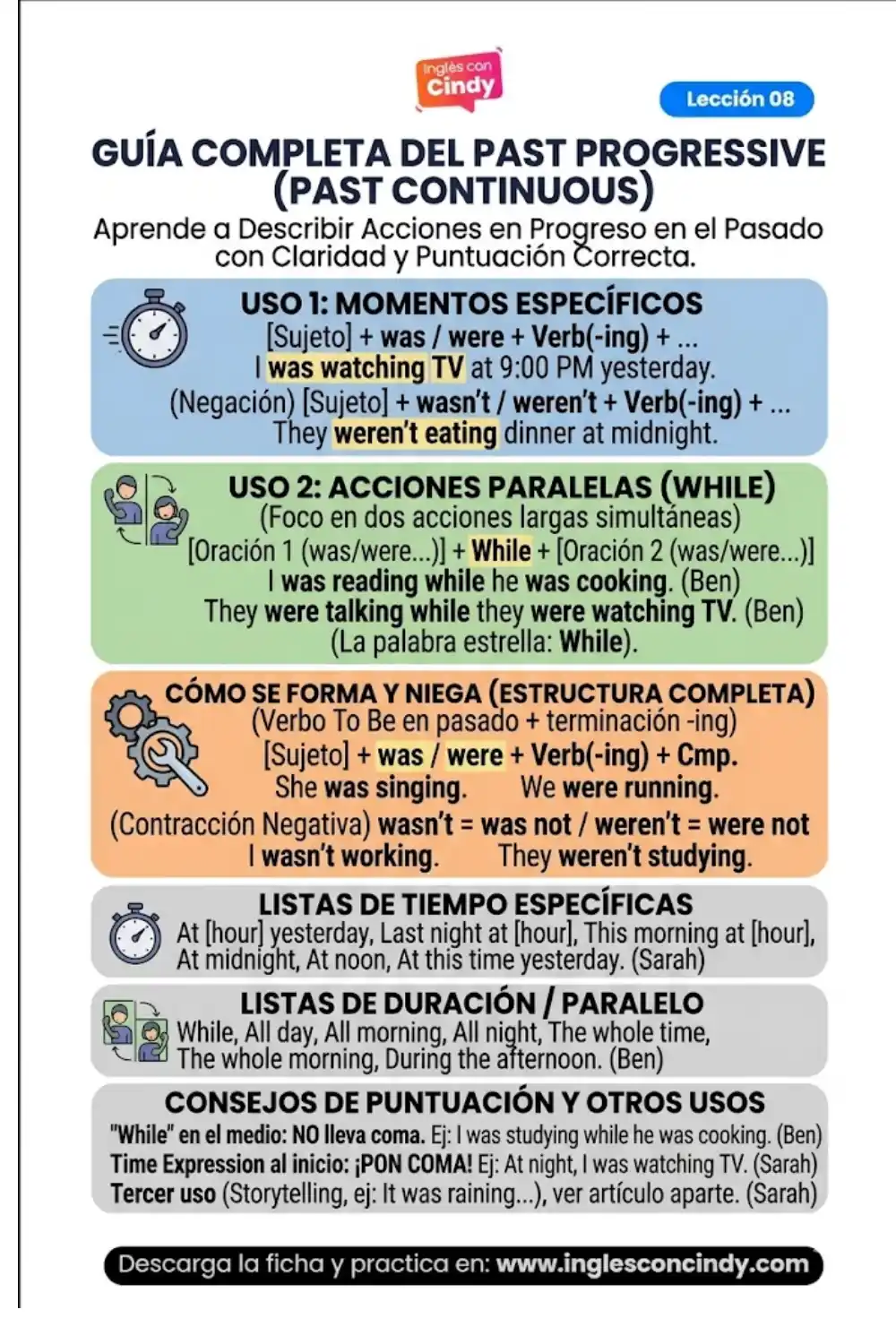
Para hacer una oración afirmativa, necesitamos nuestro sujeto, el verbo To Be en pasado (was / were) y nuestro verbo con la terminación -ing.
- I was working late.
- They were playing tennis.
Estructura Negativa (-)
Para negar, solo tenemos que agregar «not» al verbo To Be. Puedes usar las contracciones wasn’t o weren’t, que es lo más natural.
- I wasn’t working late.
- They weren’t playing tennis.
Time Expressions
Para que nuestras oraciones tengan sentido, casi siempre usamos expresiones de tiempo. Hay de dos tipos que nos interesan hoy para marcar la diferencia entre un punto congelado en el tiempo y una acción continua:
Para Momentos Específicos
Hablan de una hora o punto exacto en el reloj.
- At [hour] yesterday (ej. At 8 PM yesterday)
- Last night at [hour]
- This morning at [hour]
- At midnight
- At noon
- At this time yesterday
Para Acciones Paralelas / Duración
Hablan de un lapso de tiempo más amplio o continuo.
- While (Mientras)
- All day
- All morning
- All night
- The whole time
- The whole morning
- During the afternoon
Ejemplos: Momentos Específicos
Afirmativas (+)
Negativas (-)
Ejemplos: Acciones Paralelas y Duración
Acciones Paralelas (While)
Periodos de tiempo (All / The whole)
📝 Notas Importantes de Puntuación
La puntuación es clave para que nuestro inglés escrito sea impecable. Aquí te dejo mis recetas para ti que debes recordar sobre las comas con este tiempo verbal:
1. «While» en el medio
Cuando usas while en el medio para conectar dos acciones simultáneas, la oración NO lleva coma.
2. Time Expression al inicio
Si decides poner la expresión de tiempo exactamente al principio de tu oración, debes poner una coma inmediatamente después de ella.
🎥 ¡Repasemos juntos la Clase en Vivo!
📥 Descarga el Resumen de la Clase
Guarda la ficha de estudio de esta lección en tu celular para repasar.
⬇️ Descargar Ficha
Let’s Practice!
Choose the correct Past Progressive form to complete each sentence.
Elige la forma correcta del Pasado Progresivo para completar cada oración.
At 8:00 AM, I was drinking my coffee.
(was drinking / were drinking / drank)
The Interrogation (Missed Call)
Read the conversation and choose the correct Past Progressive form to complete it.
Lee la conversación y elige la forma correcta del Pasado Progresivo para completarla.
Alex: I called you at 8:00 AM! I was waiting for you.
(was waiting / were waiting / was wait)
Reading Comprehension Past Progressive
Read the story about the film set and choose the correct option.
Lee la historia sobre el set de grabación y elige la opción correcta.
Yesterday at 10:00 AM, the film set was completely out of control. The director wasn’t recording the movie; he was eating pizza in the corner. The main actors were practicing a dance for TikTok, and the makeup artist was sleeping on a chair. Suddenly, the producer opened the door. He was yelling because nobody was working!
Question: Was the director recording the movie at 10:00 AM?
Answer: No, he wasn’t recording it.
Yo amo enseñar, y más estos temas, porque cada vez vas a poder decir y contar más cosas.
Espero que te haya gustado la clase y este artículo que escribí con mucho cariño. ¡Sigue practicando sin parar!
¡Nos vemos en la siguiente lección! 💖
lo que repite